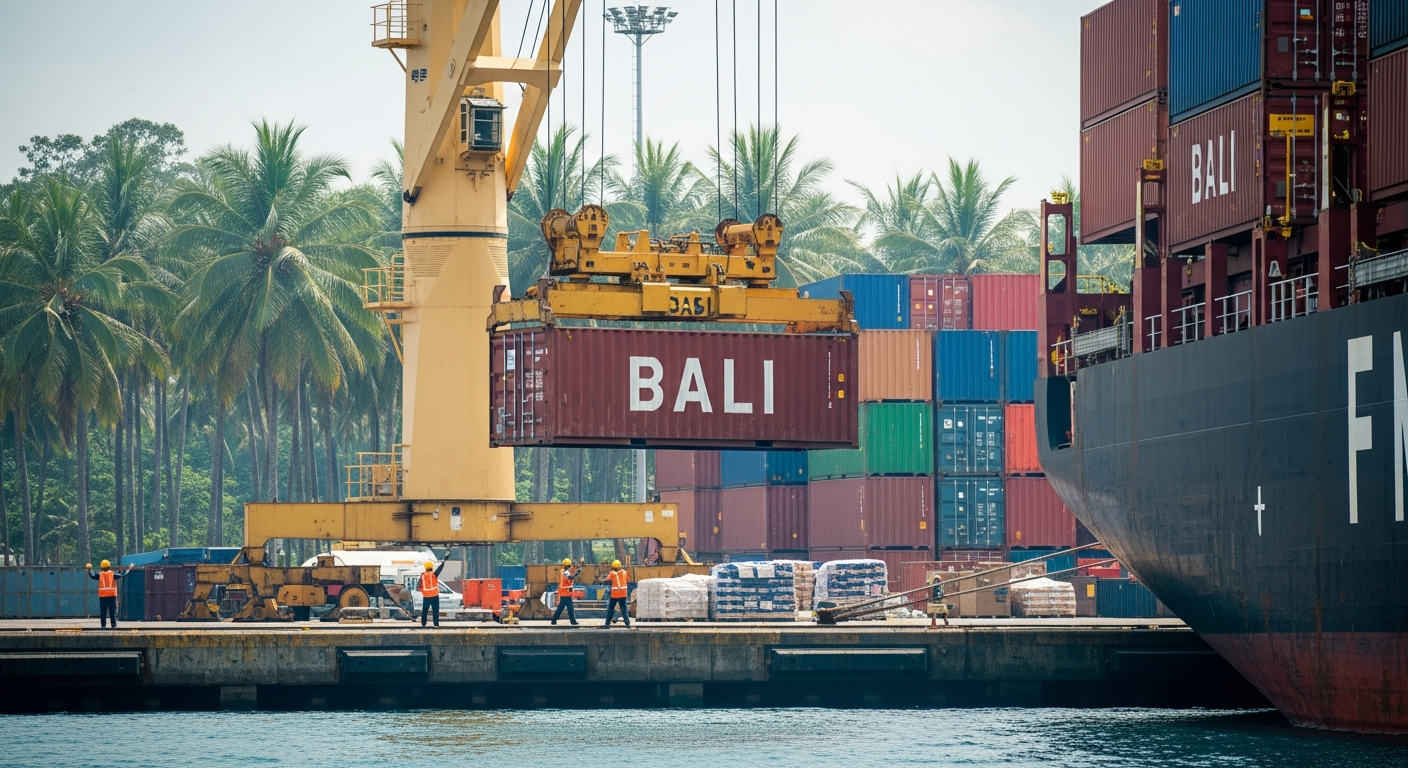
- Choose between cost-effective sea freight (28-60 days) or faster air freight (5-10 days) based on urgency and volume.
- Dedicated 20ft and 40ft containers offer secure, exclusive transport for larger shipments.
- Expert door-to-door services simplify customs clearance and final delivery across Bali.
The scent of frangipani hangs in the air, a constant reminder of your destination. Your new life in Bali awaits, a vision of sun-drenched days and vibrant culture. But first, your world must join you. Shipping to Bali transforms the complex logistics of relocating your home or business into a seamless, predictable journey, ensuring your possessions arrive precisely when and where you need them.
Your Bali Relocation: Precision and Peace of Mind
Anticipation builds as you envision your furniture, your cherished personal effects, settling into a new villa or office space on the Island of Gods. The distance from London to Denpasar spans over 12,000 kilometers, a significant journey for any shipment. Shipping to Bali understands this distance, offering a unique value proposition centered on meticulous planning and transparent execution. We manage the intricacies from your origin, whether it’s a bustling suburb in Sydney or a quiet town in the Cotswolds, right through to your doorstep in Canggu or Ubud. Our service encompasses detailed inventory management, robust packing solutions, and precise documentation handling, crucial for navigating Indonesian import regulations. Each year, over 1.6 million expatriates reside in Indonesia, many relying on specialized services to move their lives. We coordinate with reputable global carriers, ensuring your goods travel via established routes, often through major transshipment hubs like Singapore or Hong Kong, before reaching Benoa Port in South Bali. This comprehensive approach minimizes delays and unforeseen costs, providing clarity at every stage for your 2026 relocation plans.
The journey begins with a thorough assessment of your specific needs, considering factors like volume, urgency, and budget. For instance, a typical 20ft container holds approximately 33 cubic meters, enough for a three-bedroom house, while a 40ft container doubles that capacity to around 67 cubic meters, ideal for larger homes or commercial shipments. Our team provides an itemized quote, detailing sea freight or air freight options, customs duties estimates, and insurance coverage. We work with an extensive network of ground handlers and customs brokers, both at origin ports such as Felixstowe in the UK, Port Botany in Australia, or the Port of Long Beach in the US, and upon arrival at Indonesian ports. The Indonesian Directorate General of Customs and Excise (Bea Cukai) maintains strict import guidelines, with specific tariffs for personal effects often ranging from 0% to 10% for used goods, provided proper documentation like a KITAS (Temporary Stay Permit) or KITAP (Permanent Stay Permit) is presented. Our expertise guarantees adherence to these regulations, mitigating potential penalties. Since 2005, we have facilitated thousands of successful moves, a testament to our commitment to precision.
Sea Freight vs. Air Freight: Choosing Your Path to Bali
The decision between sea freight and air freight shapes the timeline and cost of your shipping to Bali. Each method presents distinct advantages tailored to different needs. Sea freight, the most economical option for larger volumes, involves transporting goods in containers aboard cargo vessels. From major European ports like Rotterdam or Hamburg, a sea freight journey to Benoa Port typically spans 28 to 45 days. From the US West Coast, say Los Angeles, transit times extend to 35-55 days, while from East Coast ports like New York, expect 45-60 days. Australian origins, such as Fremantle or Melbourne, offer shorter sea routes, generally 14-25 days to Bali. This option is ideal for furniture, vehicles, and non-urgent personal effects, where cost efficiency outweighs speed. Goods are loaded into either a Full Container Load (FCL) for exclusive use or Less than Container Load (LCL) for smaller shipments sharing space, which can add 7-10 days to the transit for consolidation and deconsolidation processes at transshipment points.
Conversely, air freight provides a significantly faster solution, crucial for time-sensitive items or smaller, high-value goods. A shipment from London Heathrow to Ngurah Rai International Airport (DPS) typically takes 5-10 days, including customs clearance. From major US hubs like Dallas/Fort Worth or Atlanta, air freight transit is comparable, often within 7-12 days. Australian cities like Perth or Sydney offer even quicker air freight, frequently arriving within 3-7 days. While faster, air freight costs are considerably higher, often 5-10 times more per kilogram than sea freight, making it less suitable for bulkier items. For instance, shipping 100 kg via air freight might cost upwards of $1,500, whereas the same volume by sea freight could be a fraction of that. We provide detailed breakdowns for both options, considering the specific weight, dimensions, and declared value of your items. Our team guides you through the pros and cons, ensuring an informed decision that aligns with your relocation schedule and budget. We track shipments using real-time GPS systems, offering updates every 24-48 hours from departure to arrival at your chosen Bali port.
Container Solutions: 20ft, 40ft, and Specialized Cargo
When relocating an entire household or substantial business inventory to Bali, containerized shipping offers security and efficiency. The standard options are 20ft and 40ft containers, each serving different volume requirements. A 20ft standard dry container, measuring approximately 6.1 meters long, 2.44 meters wide, and 2.59 meters high, provides a volumetric capacity of about 33 cubic meters. This is typically sufficient for a two-to-three-bedroom apartment or a small office setup. From key origin ports like Southampton, UK, or Port Klang, Malaysia, a 20ft container shipment to Benoa Port costs an average of $3,500 – $6,000, varying with global freight rates and specific services included. These containers are sealed at origin and opened only upon arrival at the destination, offering a robust level of security against pilferage and environmental damage during transit across the Indian Ocean.
For larger shipments, the 40ft standard dry container doubles the capacity, offering approximately 67 cubic meters. Measuring 12.2 meters long, with similar width and height, it accommodates a four-to-five-bedroom house, including vehicles, or a significant commercial consignment. The cost for a 40ft container from major hubs like Hamburg or Long Beach to Bali typically ranges from $5,000 to $9,000. Beyond standard dry containers, we also arrange specialized containers such as 40ft High Cube containers, which offer an extra foot of height (2.9 meters total), providing an additional 7-8 cubic meters of space, ideal for oversized items. We also manage open-top containers for cargo that requires loading from the top, or flat racks for extremely wide or heavy items. Our expertise extends to handling project cargo, including industrial machinery or custom-built exhibition stands, coordinating with specialized equipment at both origin and destination ports. We ensure all container movements comply with International Maritime Organization (IMO) standards, guaranteeing safe and compliant transport of your goods to Benoa Port, or through Tanjung Perak in Surabaya for onward domestic transit to Bali.
Navigating Bali Customs and Duties: An Insider’s Guide
Understanding Bali’s customs regulations is paramount for a smooth import process. Indonesia, a signatory to the Harmonized System (HS) of tariff nomenclature, applies specific duties and taxes based on item classification and value. For personal effects of expatriates holding a KITAS (Kartu Izin Tinggal Terbatas) or KITAP (Kartu Izin Tinggal Tetap), certain exemptions or reduced duties may apply, particularly for used household goods that have been owned for over one year. New items, however, are generally subject to import duties ranging from 0% to 10%, Value Added Tax (VAT) of 11%, and sometimes Luxury Goods Sales Tax (LGST) of 10-200%, depending on the item category. For example, a new refrigerator might incur 5% import duty, 11% VAT, and no LGST, while a new luxury car would face significantly higher LGST. The Indonesian Directorate General of Customs and Excise (Bea Cukai) mandates thorough documentation, including a comprehensive packing list, commercial invoice (even for personal effects), bill of lading or air waybill, and a copy of the expat’s passport and visa.
Our team works directly with licensed customs brokers in Indonesia, ensuring all necessary permits and declarations are accurately prepared and submitted. This includes the PIB (Pemberitahuan Impor Barang) for commercial goods or PIBK (Pemberitahuan Impor Barang Khusus) for personal effects. A common pitfall for new arrivals is under-declaring item values, which can lead to penalties and significant delays. Bea Cukai employs valuation methods to assess goods, and discrepancies can result in re-evaluation and fines up to 100% of the underpaid duty. Our insider knowledge helps you prepare a realistic declaration, minimizing risks. We also advise on specific items that require additional permits, such as electronics (e.g., certain telecommunications devices requiring Postel certification) or food products. For example, importing more than 10 liters of alcoholic beverages per person is generally restricted, and anything exceeding this requires special import licenses. Our comprehensive service ensures that from your origin in the UK, US, or Australia, every document is prepared to meet the stringent requirements of Indonesian customs, streamlining your entry into Bali.
Door-to-Door Service: From Global Origins to Your Bali Address
The true convenience of shipping to Bali lies in a comprehensive door-to-door service, eliminating the complexities of managing multiple logistics providers across continents. Our integrated solution begins at your current residence or business location, whether it’s in London, New York, Sydney, or Berlin. We coordinate professional packing services, utilizing industry-standard materials like custom wooden crates for fragile items, reinforced cartons, and moisture barriers, ensuring your possessions withstand the journey. Our teams handle the meticulous loading of your container, or consolidation for LCL shipments, adhering to international shipping standards. From pickup, your goods are transported to the nearest major port – perhaps Port of Felixstowe in the UK, Port of Houston in the US, or Port of Singapore – where they are processed for international transit. This initial leg of the journey is managed with precision, including all necessary export documentation and security checks, typically taking 3-7 days.
Once your shipment arrives at Benoa Port in Bali, or via Tanjung Perak in Surabaya with onward domestic transit, our local expert team takes over. We manage all port charges, container devanning, and the crucial customs clearance process with Bea Cukai. This includes handling terminal handling charges (THC), demurrage (if applicable), and all duties and taxes on your behalf, providing you with a single, transparent invoice. Our local network extends across Bali, covering popular expat destinations like Seminyak, Sanur, Uluwatu, and Canggu, as well as more remote areas. We arrange for final delivery to your villa, apartment, or business premises, including unpacking services and debris removal if requested. This end-to-end management removes the burden of dealing with unfamiliar local regulations, language barriers, and fragmented logistics chains. Since 2010, our door-to-door success rate for shipments exceeding 500 kg has consistently been above 98%, a testament to our robust operational framework and dedicated local partners, ensuring your items reach their final destination without incident.
Prohibited Items and Essential Packing Strategies for Bali
Navigating the import restrictions for Bali requires careful attention to prohibited and restricted items, alongside robust packing strategies. Indonesia maintains a strict list of goods that cannot be imported, primarily including narcotics (with severe penalties, including death sentences for drug trafficking), firearms, ammunition, explosives, pornography, and certain politically sensitive materials. Counterfeit goods, including pirated software or fake branded items, are also strictly prohibited under intellectual property laws. Additionally, specific items like certain types of cultural artifacts or endangered species products (e.g., ivory, tortoise shell) are banned under international treaties such as CITES (Convention on International Trade in Endangered Species of Wild Fauna and Flora), to which Indonesia is a signatory. Importing more than 2,500 cigarettes or 1 liter of alcohol per person is also restricted and will incur heavy duties or confiscation. Always consult the latest regulations from the Indonesian Directorate General of Customs and Excise before packing.
Effective packing is crucial for protecting your goods during transit across thousands of miles. For sea freight, items must withstand significant movement, temperature fluctuations, and potential humidity. We recommend using heavy-duty, double-walled cartons, clearly labeled with contents and destination. Fragile items should be individually wrapped in bubble wrap or foam, then secured within crates. Disassembling furniture where possible not only saves space but also reduces the risk of damage. For electronics, retaining original packaging provides the best protection; otherwise, use anti-static bubble wrap and sturdy boxes. A detailed, itemized packing list is not just a recommendation; it is a mandatory document for customs clearance, facilitating a smoother process upon arrival. This list should include descriptions, quantities, and declared values for all items. For example, a 200 kg shipment of books, clothing, and kitchenware, properly packed, significantly reduces the chances of damage compared to loosely packed items. Our packing services adhere to ISPM 15 standards for any wooden crates or pallets, preventing the spread of pests and ensuring compliance with international phytosanitary regulations.
Timelines and Insurance: Securing Your Goods for 2026
Planning your move to Bali, especially for 2026, involves understanding realistic shipping timelines and securing adequate insurance. Sea freight from major global origins typically takes 4-8 weeks from port to port. For instance, a shipment from London Gateway Port to Benoa Port could take 35-45 days. From the US West Coast, like Oakland, expect 40-55 days. Australian ports such as Brisbane offer shorter transit times, often 18-30 days. These figures represent transit time only; additional time, usually 1-2 weeks, must be factored in for pre-shipment packing, origin customs clearance, container loading, and destination customs clearance, port handling, and final delivery. This means a complete door-to-door sea freight journey can realistically take 6-10 weeks. Air freight, while faster, still requires 5-10 days for door-to-door delivery from most international airports to Ngurah Rai International Airport (DPS), including customs and local delivery.
Insurance is not merely an option; it is an essential safeguard for your valuable possessions. While carriers are liable for damage or loss, their liability is often limited by weight or volume, typically far below the actual value of your goods. For example, standard carrier liability might be around $500 per cubic meter, whereas your personal effects could be worth significantly more. We offer comprehensive marine cargo insurance policies that cover your goods from the moment they are packed at your origin address until they are delivered to your Bali destination. These policies often cover “all risks” of physical loss or damage, subject to specific exclusions. The cost of insurance is usually a small percentage of the declared value of your goods, typically ranging from 1% to 3%. For a shipment valued at $20,000, insurance might cost between $200 and $600, providing invaluable peace of mind. We work with reputable insurance providers, ensuring claims are processed efficiently, should an unforeseen event occur during the journey across the Pacific or Indian Ocean. Planning your 2026 move with a clear understanding of these timelines and insurance options ensures a secure and predictable arrival of your world to Bali.
Your journey to Bali should be as serene as the island itself. Let Shipping to Bali handle the complexities, providing clarity and confidence at every step. Ready to plan your seamless relocation? Get your personalized shipping quote today and take the first step towards your new life in Indonesia.